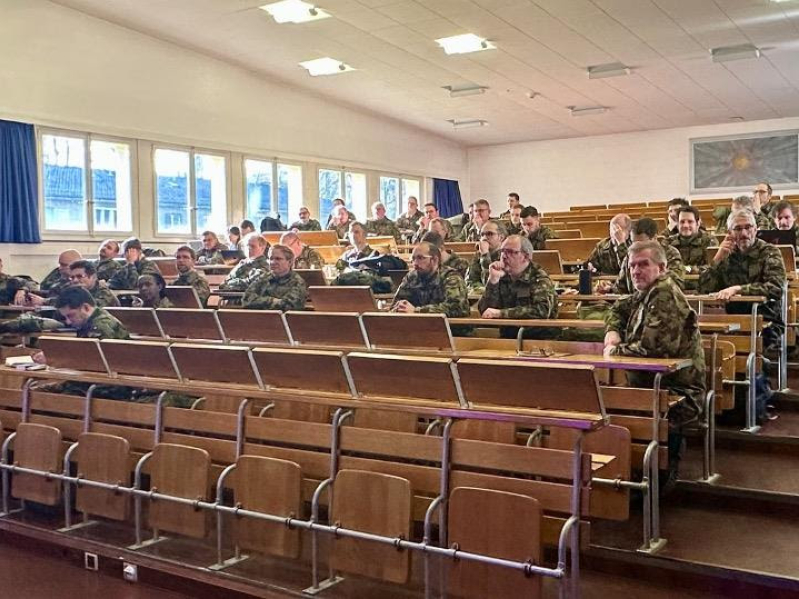
Members of the Swiss Armed Forces chaplaincy from evangelical backgrounds gathered in the nation’s capital Bern to evaluate their expanding role within the military.
About 50 participants met for a professional development day focused on the evolving demands of spiritual care in a modern, diverse army, according to the Réseau Évangélique Suisse (French-speaking Swiss Evangelical Alliance).
The gathering, held Jan. 13, marked the second professional day of its kind and highlighted a six-year formal collaboration between the military and several evangelical bodies.
"The army chaplaincy is there for everyone — regardless of religious background," said Samuel Schmid, head of the army chaplaincy, in French. He emphasized that those serving in this capacity must accompany soldiers with openness and respect, operating without a personal or proselytizing agenda.
Schmid praised the high level of motivation among evangelical chaplains but acknowledged that certain stigmas remain.
"There are prejudices — we must not ignore them," Schmid stated, adding that it is essential to remain "resolutely oriented toward the mission and the needs of people."
He cautioned against what he termed helicopter chaplaincy, where spiritual leaders appear only for occasional ceremonies. Instead, he advocated for a reliable, daily presence on the ground.
"The one who walks with others, listens, and stays, gains trust," Schmid explained.
The role requires significant self-reflection, as a chaplain's approach determines their effectiveness within the unit.
"A clear understanding of one's role can open doors — or close them," Schmid said.
He clarified that while a chaplain's personal spiritual background is not a limitation, it requires "wisdom, restraint, and a communication adapted to the situations." The goal is to remain human within the rigid system of the army, being present and accessible to all.
The professionalization of these interactions was a key theme throughout the day.
Peter Schneeberger, president of Freikirchen.ch, a network of evangelical churches, discussed the management of difficult conversations, particularly when dealing with psychological crises, burnout, or internal conflicts.
He argued that the essential condition for effective spiritual care is creating a safe framework for dialogue defined by clarity and trust.
Christian Haslebacher, vice president of Freikirchen.ch, further noted that relational competence and a focus on dignity and reconciliation should take precedence over religious jargon.
The meeting also included practical accounts from the field. Chaplains shared stories of their work during long marches, on weapons ranges, and within staff headquarters. A particularly poignant moment involved a delegation of pastors who recently participated in the Military Prayer Breakfast in Kyiv. Their firsthand accounts of the reality of war underscored the critical importance of spiritual accompaniment in extreme conditions. In such high-stakes environments, denominational differences often fade, leaving proximity and encouragement as the primary goals.
The group also addressed interreligious sensitivity, citing the support of Muslim soldiers during Ramadan as a successful example of coexistence within the Swiss military daily routine. This demonstrated that the chaplaincy is equipped to handle the needs of a pluralistic force while maintaining its own professional standards.
In closing, Schmid addressed the impact of global crises on the chaplaincy. "We must remain attentive, but we must not let ourselves be paralyzed," he told the participants.
He clarified that while political positioning is not part of their mission, "hope and orientation" in uncertain times are core responsibilities.
The day concluded with a shared consensus that the primary goal of the military chaplaincy is to maintain a sense of humanity within the structure of the army by being professional and accessible representatives of the values found in the Gospel.
The collaboration involves Freikirchen.ch, the Schweizerische Evangelische Allianz (German-speaking Swiss Evangelical Alliance), and the Réseau Évangélique Suisse.